Hot Tub Water Care Made Simple: A Complete Week-by-Week Chemistry Guide
Cloudy water, foam, itchy skin and that chlorine smell all trace back to the same handful of causes. This is the water-care routine our service techs actually use — what to test, in what order to correct it, and how to keep a spa clear with about five minutes a week.
Water care is the part of hot tub ownership that intimidates new owners and frustrates experienced ones. It should not. A hot tub is a small, closed, heated body of water with a predictable set of variables, and once you understand the order those variables affect each other, the whole thing collapses into a five-minute weekly habit and a twenty-minute quarterly one.
The trouble is that most people learn water care backwards. They react to a symptom — cloudy water — by adding the product whose label mentions cloudy water, get a temporary improvement, and repeat until the spa is a chemical soup with 2,500 ppm of dissolved solids that no amount of shock will fix. Then they drain it, and the cycle starts again.
This guide inverts that. We will start with the four numbers that determine everything, explain why the correction order is non-negotiable, then walk through a realistic weekly and monthly routine, cover the common problems with their actual root causes, and finish with the drain-and-refill process that resets everything. It applies to any residential spa — Jacuzzi, Sundance, American Whirlpool, Vita Spas, or anything else with a filter and a heater.
The four numbers that run your spa
Everything in spa water care reduces to four measurements: total alkalinity, pH, sanitizer level, and calcium hardness. Total dissolved solids is a fifth number, but it is not something you adjust — it only tells you when to drain.
Total alkalinity (TA) is the buffer. It measures the water's ability to resist pH change, and the target range is roughly 80-120 ppm. When TA is low, pH becomes unstable and bounces after every soak or chemical addition. When TA is high, pH locks in stubbornly high and scale becomes likely. Alkalinity is the foundation, which is why it is corrected first, always.
pH is the acidity of the water, targeted at 7.4-7.6. Sanitizer effectiveness is extremely sensitive to it: chlorine at pH 8.0 is a fraction as effective as chlorine at 7.4. Low pH corrodes heater elements, pump seals and jet hardware; high pH causes scale, cloudy water and reduced sanitizer performance. Almost every 'my sanitizer reads fine but the water is cloudy' complaint is a pH problem.
Sanitizer is chlorine or bromine, the thing actually killing bacteria. Target 1-3 ppm free chlorine, or 3-5 ppm bromine. Calcium hardness, target 150-250 ppm, prevents the water from being aggressive toward the shell, heater and seals when it is too soft, and prevents scale when it is too hard. Soft municipal water in parts of our region genuinely needs calcium added, which surprises a lot of new owners.
- Total alkalinity: 80-120 ppm — correct this first.
- pH: 7.4-7.6 — correct second.
- Free chlorine 1-3 ppm or bromine 3-5 ppm — correct third.
- Calcium hardness: 150-250 ppm — check monthly.
- Total dissolved solids: drain when it exceeds roughly 1,500 ppm over fill.
Why correction order is non-negotiable
If you correct pH before alkalinity, you will spend the next week chasing pH. Alkalinity is what holds pH in place; adjusting pH in unbuffered water is like trying to steer a car with no wheel alignment. Add alkalinity increaser, circulate for at least twenty minutes with the cover open, then retest before touching pH at all.
Similarly, adding sanitizer to water with a pH of 8.2 wastes product. The chlorine goes in, reads on the strip, and does very little disinfecting because at that pH most of it exists in the ineffective hypochlorite form. Owners then add more, drive the total chlorine higher, generate more chloramines, and end up with the strong chemical smell that people wrongly interpret as 'too much chlorine.' It is actually the smell of chlorine that has already been used up and needs shocking out.
The order is: alkalinity, then pH, then sanitizer, then hardness. Wait and circulate between each step. Never add two different chemicals to the water at the same time — some combinations react directly and violently, and all of them make it impossible to know which adjustment caused which result.
One more rule that saves a lot of grief: always add chemicals to water, never water to chemicals, and always dose with jets running and the cover open so the product disperses and off-gasses instead of concentrating against the shell surface.
The realistic weekly routine
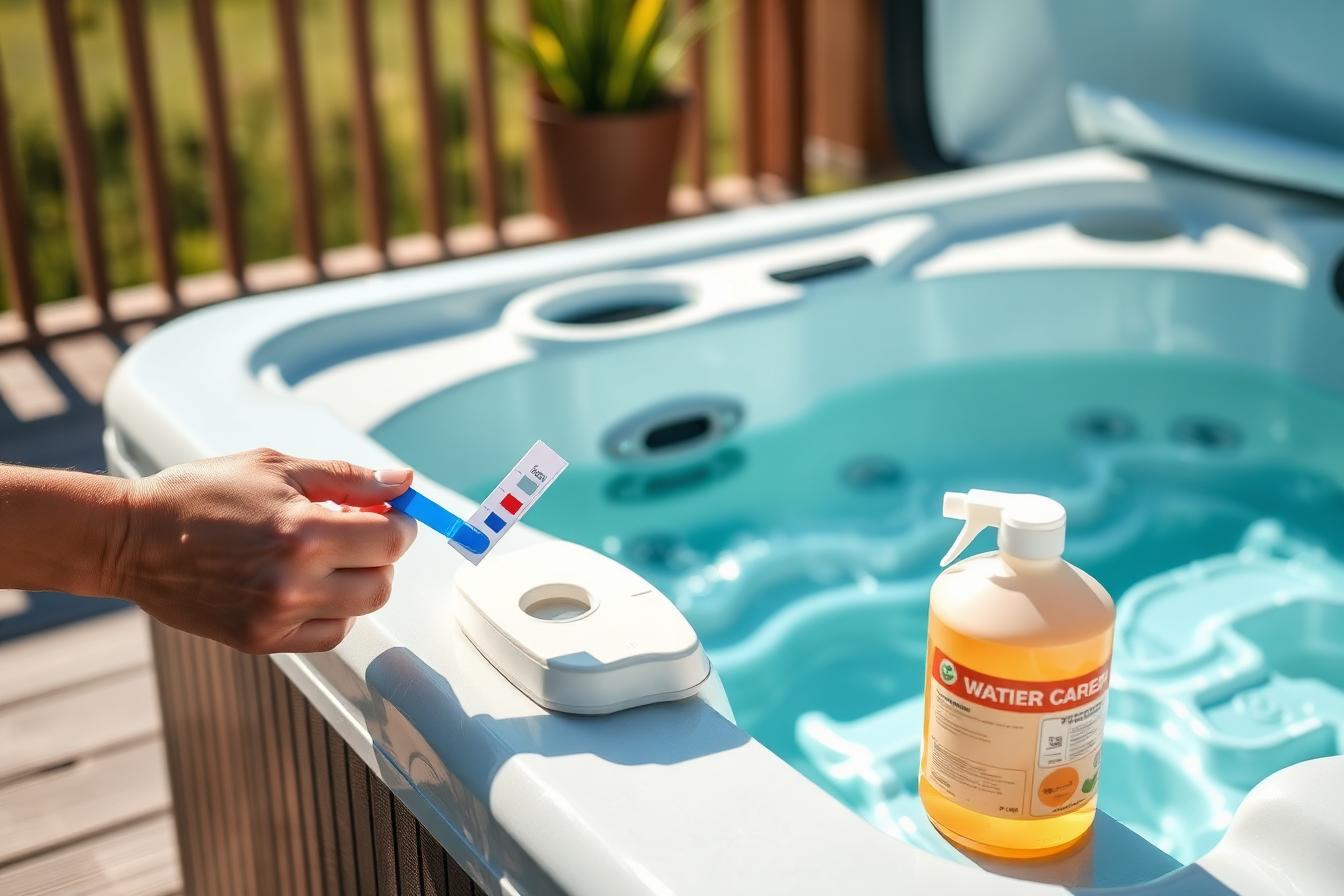
Twice a week, test with a fresh strip or a liquid kit. Strips are fine for routine monitoring as long as they have not been sitting open in a humid cabinet since last summer — moisture ruins them, and a bad strip produces confident wrong answers. Keep the bottle sealed and stored indoors, and replace it annually.
Once a week, shock the water. Shocking is not the same as sanitizing. Sanitizer maintains a residual; shock is a large dose of oxidizer that burns off the combined chloramines, body oils, lotions and organic material that accumulate and cause odor and dullness. Use a non-chlorine shock for routine weekly maintenance and a chlorine shock after heavy use or if you suspect a contamination issue.
Also weekly: wipe the waterline. The scum line that forms at the surface is the accumulated oils that the filter cannot capture, and if you never wipe it, it hardens into a stain that eventually needs a chemical cleaner. Thirty seconds with a spa-safe wipe or a soft cloth handles it.
Time it around use. The single most efficient habit is testing right before you get in and shocking right after everyone gets out. That way the shock does its work overnight with the cover cracked and you are not making a separate trip to the spa at 6 a.m.
- Twice weekly: test alkalinity, pH and sanitizer.
- Weekly: shock, wipe the waterline, check the water level.
- After heavy use: shock again rather than waiting for the schedule.
- Always dose with jets on and the cover open.
Filters: the maintenance item everyone underestimates
A spa filter is a mechanical device with a finite capacity, and it is doing far more work than most owners realize. Every gallon of water in your spa passes through it many times a day, capturing hair, skin cells, lotion, pollen, insects and the fine particulates that make water look dull. When it clogs, flow drops, the heater struggles, the pump works harder, sanitizer distribution suffers, and — in winter — freeze protection loses effectiveness.
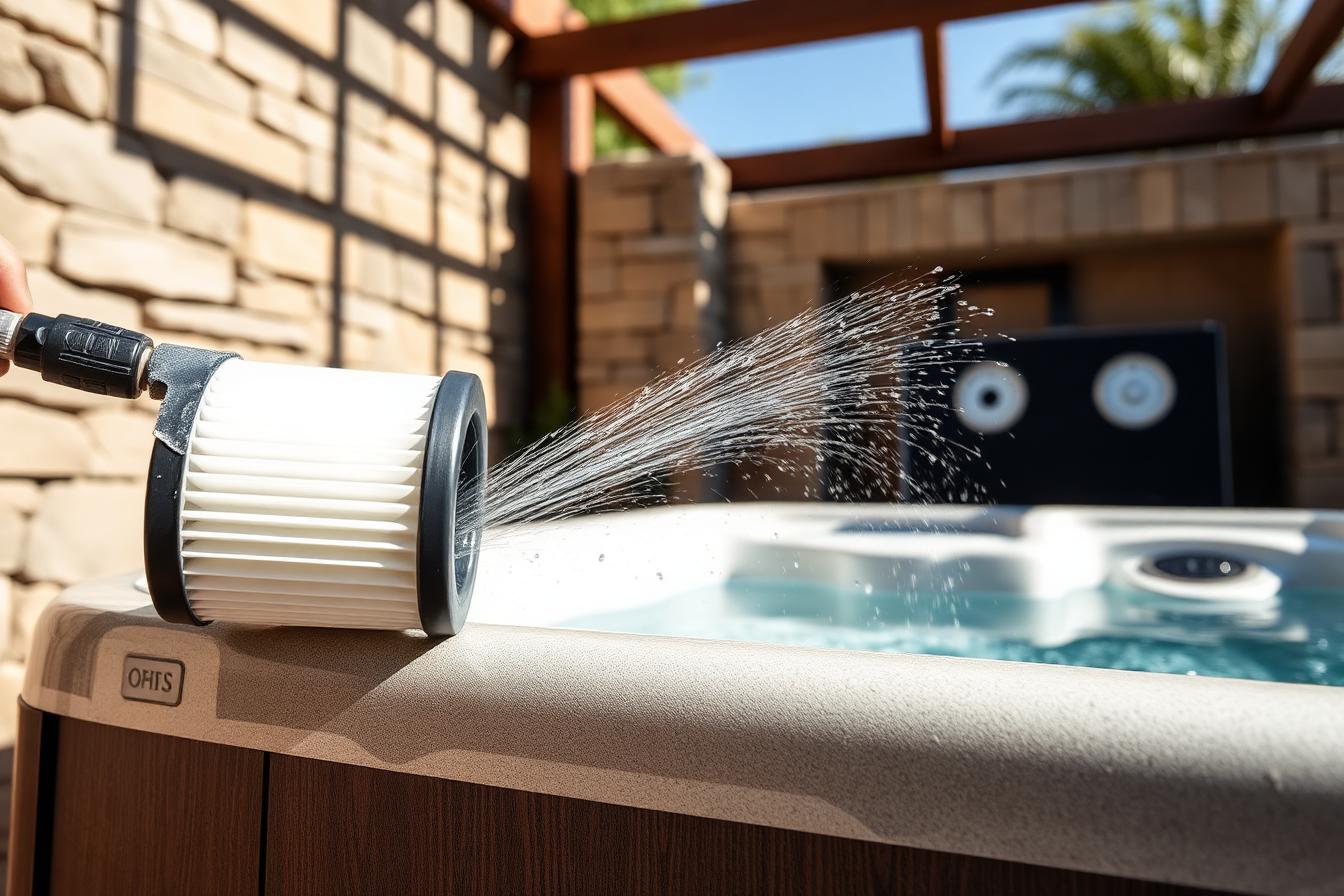
Rinse the filter every two to four weeks. Take it out, spray between every pleat with a hose nozzle from top to bottom, and reinstall. This takes five minutes and is the highest-value maintenance action per minute spent in the entire hobby.
Every three months, deep-clean by soaking in a dedicated filter cleaner overnight, then rinsing thoroughly and letting it dry completely before reinstalling. This is why we recommend owning two sets of filters and rotating them: one in the spa, one clean and dry on the shelf. Reinstalling a wet filter that still contains cleaner residue is a classic cause of persistent foaming.
Replace cartridges every 12 to 24 months depending on use. Pleats compress and fibers break down with repeated cleaning; a filter that looks fine can have lost much of its filtration capacity. If deep-cleaning no longer restores clarity, the cartridge is done.
Diagnosing the five most common water problems
Cloudy water. The instinct is to add sanitizer; the actual cause is usually one of high pH, a saturated filter, or high total dissolved solids. Test pH first and correct it. Then rinse the filter. If neither fixes it within 24 hours of circulation, check TDS — if the water is more than 1,500 ppm above your fill water, it is chemically exhausted and no product will restore it. Drain and refill.
Foam. Foam is surfactants: soap residue in swimsuits, lotions, hair products, detergents. Anti-foam products break the bubbles but do not remove the cause, which is why the foam returns in a day. The real fix is source control — rinse swimsuits in plain water, skip laundry detergent on spa suits, shower before soaking — plus an enzyme product to digest the organics and, in bad cases, a drain and refill.
Strong chlorine smell. Counterintuitively, this means not enough free chlorine. The odor comes from chloramines, the spent compounds formed when chlorine binds with contaminants. The fix is to shock, which oxidizes the chloramines away. Water that is properly sanitized smells like almost nothing.
Itchy skin or eye irritation. Nearly always a pH problem, occasionally a very high sanitizer level immediately after shocking. Correct pH to 7.4-7.6 and wait for free chlorine to fall below 5 ppm before soaking.
Green or slimy surfaces. Algae is rare in a covered, heated spa but happens after prolonged neglect or when a spa is filled with untreated well or surface water. This calls for a superchlorination and a full drain, plus a line flush product to clear biofilm from the plumbing before refilling.
Draining, cleaning and refilling the right way
Plan on a full water change every three to four months for typical household use. The rule of thumb is to divide the gallon capacity by the average number of daily bathers times twelve; a 400-gallon spa used by two people daily works out to roughly every 16 weeks. Heavier use shortens that considerably.
The step most people skip is the line flush. Before draining, add a plumbing cleaner and run the jets for the recommended time. The interior of a spa's plumbing accumulates biofilm — a slick bacterial layer that hides from sanitizer and reseeds the fresh water within days of a refill. If you have ever drained a spa and had the new water go cloudy in 72 hours, biofilm is why.
After draining, clean the shell with a non-abrasive spa surface cleaner, paying attention to the waterline, the footwell and around the jets. Pull the filters and deep-clean or replace them. Wipe the underside of the cover with a mild cleaner and treat the vinyl top with a UV protectant.
Refill through the filter housing rather than dropping the hose into the footwell. Filling through the filter compartment pushes water up through the plumbing and dramatically reduces trapped air, which is the most common cause of the dreaded post-refill flow error. Once full, balance in the correct order — alkalinity, pH, sanitizer, hardness — and let it circulate for at least an hour before anyone gets in.
- Use a plumbing line flush before every drain.
- Deep-clean or replace filters at every water change.
- Refill through the filter housing to avoid air locks.
- Balance in order and circulate an hour before the first soak.
Chlorine, bromine, salt and mineral systems compared
Dichlor granular chlorine is the default for most residential spas: inexpensive, fast-acting, widely available, and easy to dose. Its downside is that it adds cyanuric acid over time, which gradually reduces effectiveness and contributes to TDS, and it dissipates faster at spa temperatures than in a pool.
Bromine is more stable at high temperatures and produces less odor, which makes it popular with owners who are sensitive to chlorine smell or who use their spa heavily. It works more slowly, needs a feeder or floater for consistent delivery, and cannot be shocked away as easily since bromine regenerates rather than dissipating.
Salt-water systems generate chlorine on demand from a low salt concentration, producing gentler-feeling water and far less hands-on dosing. They are excellent for consistency but require a cartridge or cell that needs periodic replacement, and they do not eliminate testing — pH still drifts and still needs correcting.
Mineral cartridges, ozone and UV are supplements, not replacements. They reduce the amount of chlorine or bromine required, sometimes substantially, but every one of them still requires a measurable sanitizer residual in the water. Any system that promises zero sanitizer in a heated, shared body of water is making a claim that public health guidance does not support.
Building a five-minute habit
The owners with consistently beautiful water are not the ones with the most chemistry knowledge; they are the ones with the shortest distance between intention and action. Keep the test strips, the shock and the pH adjusters in a small caddy right at the spa, indoors or in a weather-tight deck box. If your supplies live in the garage across the yard, testing will not happen in February.
Write your target numbers on the inside lid of the caddy. Not everyone remembers whether alkalinity is 80-120 or 100-150, and a two-second glance removes the excuse to skip a test.
Log results for the first two months. A simple note on your phone with date, TA, pH and sanitizer will reveal your spa's personal pattern — how fast pH climbs, how much chlorine a typical soak consumes — and after eight weeks you will be dosing predictively rather than reactively. That is the point at which water care stops feeling like a chore.
And when something goes sideways, bring us a water sample. Splash City tests water for free at all three showrooms, and a ten-minute lab test that identifies a hardness or TDS problem beats three weeks of adding products that were never going to work.
Frequently asked questions
Talk to the Splash City team
Showrooms in Sioux Falls, Sioux City and Rapid City. Bring a water sample, a room measurement or a backyard photo — we will help you plan it.
Flexible monthly payments with quick approvals and competitive rates — apply in minutes.