Designing a Four-Season Outdoor Living Space in the Upper Midwest
A patio that only works in July is a patio you use six weekends a year. Here is how to plan zones, heat, shade, wind protection, lighting and furniture that keep a Dakota backyard comfortable from April through November — and usable even in January.
The gap between a backyard that gets used and one that does not is almost never about budget. It is about comfort engineering. Two households can spend the same money — one ends up with a beautiful concrete rectangle holding furniture nobody sits in, and the other ends up with a space that pulls people outside on a windy April evening and again on a cool October night.
The difference comes down to a short list of variables: wind, shade, warmth, light, seating comfort, and how far the space is from the kitchen. Get those right and a patio in South Dakota or Iowa is comfortable from mid-April through early November, plus a surprising number of clear winter evenings around a fire. Get them wrong and the space is pleasant for about six weekends a year in the narrow window where the weather does the work for you.
This guide walks through designing for our actual climate — prairie wind, intense summer sun, dramatic shoulder seasons and long winters — with attention to the practical decisions that determine comfort: zoning, wind mitigation, heat sources, shade structures, lighting layers, furniture materials that survive freeze-thaw cycling, and the storage plan that keeps everything looking good in year eight.
Zone the space before you buy anything
Every outdoor space that works well is really three or four smaller spaces with different jobs. A dining zone near the door for meals. A lounge zone oriented around a focal point — a fire table, a view, a hot tub. A cooking zone with counter space and a landing surface. Sometimes a quiet zone or a play zone at the edge. When these overlap, the space feels chaotic; when they are distinct, even a small patio feels generous.
Start with adjacency. The dining zone should be the closest to the kitchen door, because every additional step between the grill, the table and the refrigerator reduces how often anyone bothers to eat outside. This one decision predicts outdoor dining frequency better than the quality of the furniture.
Define zones physically rather than only conceptually. A change in paving material, a low wall, a planter run, a pergola overhead, or even a large outdoor rug tells people where a zone starts and stops. In an open backyard with no vertical structure, furniture floating in the middle of a slab always feels unmoored, which is why people sit in it less.
Then walk the traffic paths. If people have to squeeze between a chair and a railing to reach the yard, that chair will get pulled out of position permanently. Leave three feet of circulation around seating groups and behind dining chairs, and keep the primary route from the door to the yard clear of everything.
- Dining zone closest to the kitchen door.
- Lounge zone anchored by a fire feature, view or spa.
- Three feet of circulation around seating and behind dining chairs.
- Use paving changes, planters or overhead structure to define edges.
Wind is the variable everyone ignores
On the prairie, wind is the single biggest determinant of outdoor comfort, and it is almost always underweighted in patio design. A 72-degree evening with a 20 mph wind is unpleasant; the same evening at 5 mph is perfect. Wind also blows out candles, drives smoke, cools food, tips umbrellas, moves cushions and makes conversation difficult.
Identify your prevailing direction — in most of our region that is northwest in winter and south to southeast in summer — and plan a barrier on the dominant side. Solid fencing works but creates turbulence on the leeward side; a semi-permeable barrier such as slatted fencing, a louvered screen or a dense planting actually performs better by diffusing rather than deflecting the flow.
Landscaping is the most attractive long-term solution. A staggered row of arborvitae, spruce or serviceberry on the windward side matures into a windbreak that also provides privacy and softens the space visually. Plan for mature size, not nursery size, and keep it far enough from the patio to avoid root and debris problems.
For faster results, use built structures: a pergola with adjustable louvers, a partial privacy wall behind the lounge grouping, or retractable screens on a covered porch. Screens in particular transform a covered patio into a genuinely three-season room for a fraction of the cost of enclosing it.
Heat: what actually extends the season
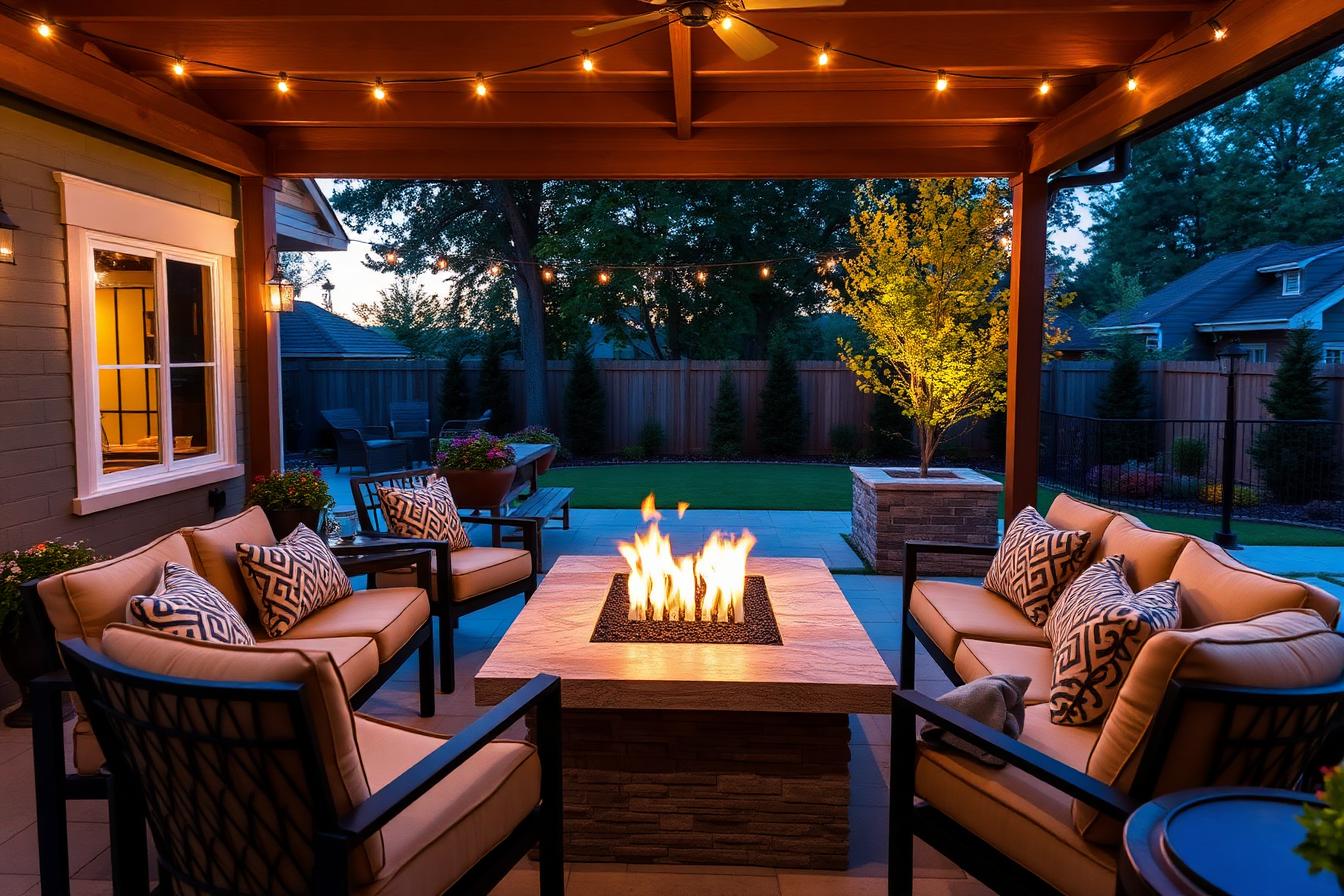
Heat is what converts a summer patio into a three-season one, and the options are not equivalent. A gas fire table is the workhorse of Midwest outdoor living: instant on, no smoke, no wood to store, adjustable output, and — critically — it is a social focal point that gives a seating group a reason to exist. Brands like Oriflamme build fire tables specifically as furniture, so the unit reads as a dining or coffee table rather than a piece of equipment.
A wood-burning fire pit delivers more heat and more atmosphere but requires fuel storage, produces smoke that chases people around the circle, and is subject to burn restrictions and code setbacks in many municipalities. It suits larger, more rural properties better than tight suburban lots.
Radiant patio heaters — overhead electric or infrared units, or freestanding propane towers — are the right answer for dining zones, where a table in the middle prevents a fire feature. Overhead-mounted electric infrared units under a covered porch are especially effective because they heat people and surfaces directly rather than trying to warm moving air.
The most underrated heat source is an outdoor fireplace or a masonry wall that stores solar gain, but the practical version for most homeowners is simply orientation. A patio on the south or west side of a house collects afternoon sun and radiates it back into the evening; the same patio on the north side is ten degrees colder in perception all season.
- Gas fire table: instant, smokeless, doubles as furniture — the best all-rounder.
- Wood fire pit: more heat and atmosphere, but smoke, fuel storage and code limits.
- Overhead infrared: best for dining zones and covered porches.
- Orientation: south and west exposures extend the usable season for free.
Shade and sun control
Midwest summer sun is intense, and an unshaded patio is unusable from about eleven to five in July regardless of temperature. Shade is not a luxury item; it is what makes the middle of the day available.
Cantilevered umbrellas are the most flexible option: they move with the sun, cover a full seating group without a center pole, and store away in winter. Buy one with a substantial base — prairie wind destroys underweighted umbrellas routinely — and get in the habit of closing it whenever you leave the yard.
Pergolas provide architectural shade and a mounting structure for lights, fans, heaters and screens. A fixed-louver pergola gives partial shade all day; an adjustable-louver system lets you dial coverage and shed rain. Retractable canopy pergolas split the difference at a lower cost.
Shade sails are inexpensive, contemporary and effective if properly tensioned to solid anchors, though they take a beating in high wind. And do not overlook trees: a single well-placed deciduous shade tree on the west side of a patio provides summer shade and, once its leaves drop, lets in the low-angle sun that makes an October afternoon comfortable. That seasonal automatic adjustment is something no manufactured product replicates.
Lighting in layers
Lighting determines whether a space is usable after sunset, which in November is 5 p.m. The mistake almost everyone makes is a single bright fixture on the house wall, which flattens the space, blinds anyone facing it and creates a harsh pool of light with darkness beyond.
Build three layers instead. Ambient light provides overall fill — string lights across a pergola, wall sconces, or a soft downlight from a tree. Task light covers the specific places where people do things: the grill surface, the outdoor bar, the steps. Accent light adds depth by uplighting a tree, grazing a stone wall or washing a planting bed.
Keep everything warm and dim. Outdoor lighting should be 2700K or warmer and considerably dimmer than most people expect; the goal is to see comfortably, not to illuminate a work site. Dimmers on every circuit are worth the wiring cost. Low-voltage landscape systems are easy to expand and safe to work on yourself.
Do not forget safety lighting on any level change. Step lights, riser lights and railing lighting prevent the most common backyard injury, and they are far more attractive than a floodlight aimed at the stairs.
- Ambient: string lights, sconces, downlighting from structure or trees.
- Task: grill, bar, prep surfaces, steps.
- Accent: uplighting trees, grazing walls, washing planting beds.
- Use 2700K or warmer, dim everything, and light every level change.
Furniture that survives a Dakota year
Outdoor furniture in this climate faces UV, hail, wind, driving rain, repeated freeze-thaw cycles and often several months under snow. That eliminates a lot of what is sold at big-box stores each spring, which is engineered to last about three seasons.
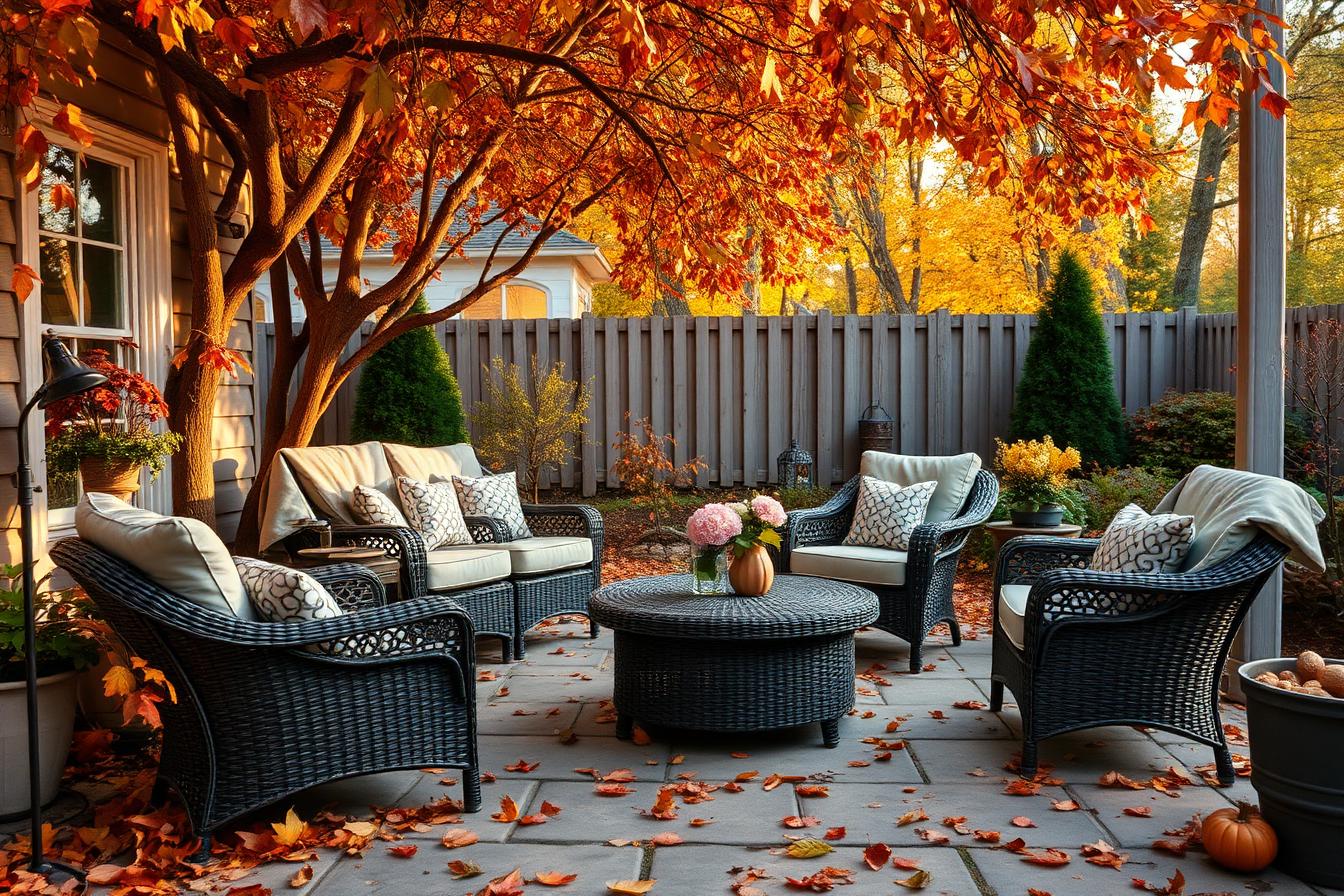
Powder-coated aluminum is the workhorse frame material: it does not rust, it is light enough to rearrange, and quality powder coating survives UV for many years. Manufacturers like Homecrest build aluminum furniture specifically for northern climates. High-density polyethylene lumber — the recycled-plastic material used in poly-resin furniture — is essentially impervious to weather, heavy enough to stay put in wind, and never needs refinishing. All-weather wicker over an aluminum frame gives the woven look with real durability, though quality varies enormously and cheap resin wicker becomes brittle within a few winters.
Teak and other hardwoods are beautiful and durable but require either annual oiling or acceptance of a silver-grey patina, and they are heavy. Steel frames rust wherever the coating chips, which will happen. Untreated softwood is a two-year purchase.
Cushions and fabrics deserve as much attention as the frames. Solution-dyed acrylic fabrics — the category Sunbrella made famous — have color dyed into the fiber rather than printed on the surface, so they resist fading and mildew far better than printed polyester. Quick-dry foam cores let cushions shed water rather than holding it, which matters enormously in a climate with regular thunderstorms. Both cost more up front and both roughly triple usable life.
Storage, covers and the maintenance plan
The single biggest factor in how outdoor furniture looks in year eight is whether it was stored or covered. Cushions should come inside — a deck box, a garage shelf, or a dedicated cushion storage bench — during winter and during extended periods of rain. Fabric left out through a Dakota winter will mildew under the snow even if it is rated for weather.
For frames, quality fitted covers are worth it. Look for breathable fabric rather than solid vinyl; non-breathable covers trap condensation and cause more damage than they prevent. Secure covers against wind, and check them after storms.
Build a simple seasonal rhythm. In spring, wash frames with mild soap, check and tighten fasteners, touch up any coating chips, and clean cushion covers. Midsummer, rinse everything and re-treat fabrics with a water repellent if they are absorbing rather than beading. In fall, deep-clean, dry completely before storage, and drain and store anything that holds water — fountains, umbrella bases, fire table burners get covered.
Fire features need specific attention. Cover the burner when not in use, keep the media dry, disconnect and store propane tanks per manufacturer instructions in winter, and clear insect nests from gas orifices in spring. A blocked burner orifice is the most common reason a fire table will not light on the first warm evening in April.
- Bring cushions indoors for winter and extended wet periods.
- Use breathable fitted covers, not solid vinyl.
- Spring: wash, tighten hardware, touch up coating, re-treat fabric.
- Fall: deep clean, dry fully, store, cover fire feature burners.
Putting it together on a real budget
You do not need to build the whole thing in one season, and the households happiest with their outdoor spaces generally did not. The productive sequence is: get the surface and layout right first, then buy the seating, then add the fire feature, then layer in shade, lighting and refinements over the following two or three years.
Spend disproportionately on the things that are hard to change later — the paving, the grade and drainage, any structure, and the electrical and gas rough-ins. Running a gas line and a couple of exterior circuits during an existing project costs a fraction of adding them afterward, and having them available means the fire table and lighting you add in year three do not require tearing anything up.
Spend well on seating, because uncomfortable furniture is the reason most patios go unused. Sit in it before buying. Check seat depth, back angle, cushion thickness and armrest height the same way you would with living room furniture, because that is exactly what it is.
And design around whatever your anchor is. If there is a hot tub, the whole layout should serve the path between the door, the spa and a place to sit afterward. If there is a pool, the shade and seating follow the water. If neither, the fire feature becomes the anchor. Splash City's showrooms in Sioux Falls, Sioux City and Rapid City carry Homecrest furniture, Oriflamme fire tables and the accessories that tie a space together — and our team is happy to work from your photos and dimensions to plan a layout before you buy a single chair.
Frequently asked questions
Talk to the Splash City team
Showrooms in Sioux Falls, Sioux City and Rapid City. Bring a water sample, a room measurement or a backyard photo — we will help you plan it.
Flexible monthly payments with quick approvals and competitive rates — apply in minutes.